
Vea también


 07.10.2026 08:59 AM
The 10-year US Treasury yield is holding around 5.3%, near 2002 levels. Against this backdrop, Bridgewater founder Ray Dalio has warned of a risk of a debt crisis within three years. He argues the US government bond market is becoming increasingly vulnerable because demand is falling from China and Japan, the two largest foreign creditors of the United States. In that scenario, holders of long-dated bonds and the government itself lose out as debt servicing becomes more expensive. Winners would be those who shifted into gold and other assets not dependent on faith in dollar-denominated debt.

Dalio's logic is straightforward. China is reluctant to keep expanding its holdings of US Treasuries because it sees economic and geopolitical risk in doing so. Japan, he says, is already trimming its holdings and wants to repatriate capital. For Japan, this is understandable: the Bank of Japan has raised interest rates to 1.25%, the highest since 1995, 10-year JGB yields have approached 3%, and investing domestically has become comparatively more attractive. When the two largest buyers step back, others must absorb issuance, and yields rise.
The market is already sensing the issue. US government debt has reached $40 trillion, and this year, spending will exceed revenues by nearly $2 trillion. The Treasury's attempt to support the market by buying bonds in August and September failed to stick: 30-year yields returned to pre-program levels. At the time, Scott Bessent said rising borrowing costs reflected global trends, but to investors, that sounded like reassurance rather than a fix.
The second part of Dalio's warning focuses on artificial intelligence. It is becoming harder for large tech firms to finance massive AI investments. Where they once raised capital by issuing equity, they are increasingly borrowing. That ties two risks together: a weakening bond market and greater corporate leverage to build infrastructure.
Dalio allows for the possibility that the AI bubble could burst. Triggers, he suggests, could be the need to repay debt or the introduction of a wealth tax. This is not a short-term prediction but a scenario in which companies accustomed to cheap money suddenly operate in a world where borrowing costs are 5.3% and rising.
Yet equities are behaving as if there is no problem. The S&P 500 is printing record highs, as is the Nasdaq 100. Gold, by contrast, is not rallying: it trades near $4,120, below two key moving averages, since high yields and a strong dollar outweigh safe-haven bids.
What does this imply for currencies? If demand for US Treasuries weakens, the dollar faces a double hit: rising yields currently support it, but a loss of confidence in US debt would eventually pressure the currency. For now, that has not happened, so the dollar remains a defensive asset close to its yearly high and benefits from Europe's troubles. Dalio's comment, however, points to where a reversal could come from, not from weak economic data but from creditors stepping away from financing the US deficit.
In my view, the coming weeks will show how seriously the market takes this risk. Weak auction demand and a hawkish Fed minutes release on Wednesday could push yields higher and hit equities, while steady demand would allow markets to defer alarm. If the 10-year yield firmly holds above 5.3%, pressure on equity valuations will likely intensify, and Dalio's warnings will start to look less hypothetical.
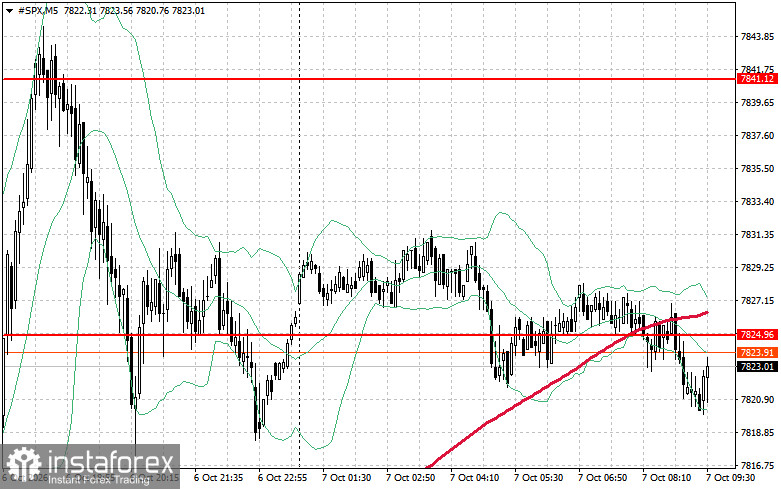
On the S&P 500 technicals, the immediate task for buyers today is to overcome the resistance level of $7,824. That would signal upside and open the door to a push toward $7,841. Controlling $7,860 is also a priority for bulls to strengthen their position. If the price moves lower amid declining risk appetite, buyers must show up near $7,810. A break below that level would likely drive the instrument down to $7,793 and open the way to $7,774.


