
See also


 31.07.2026 05:15 AM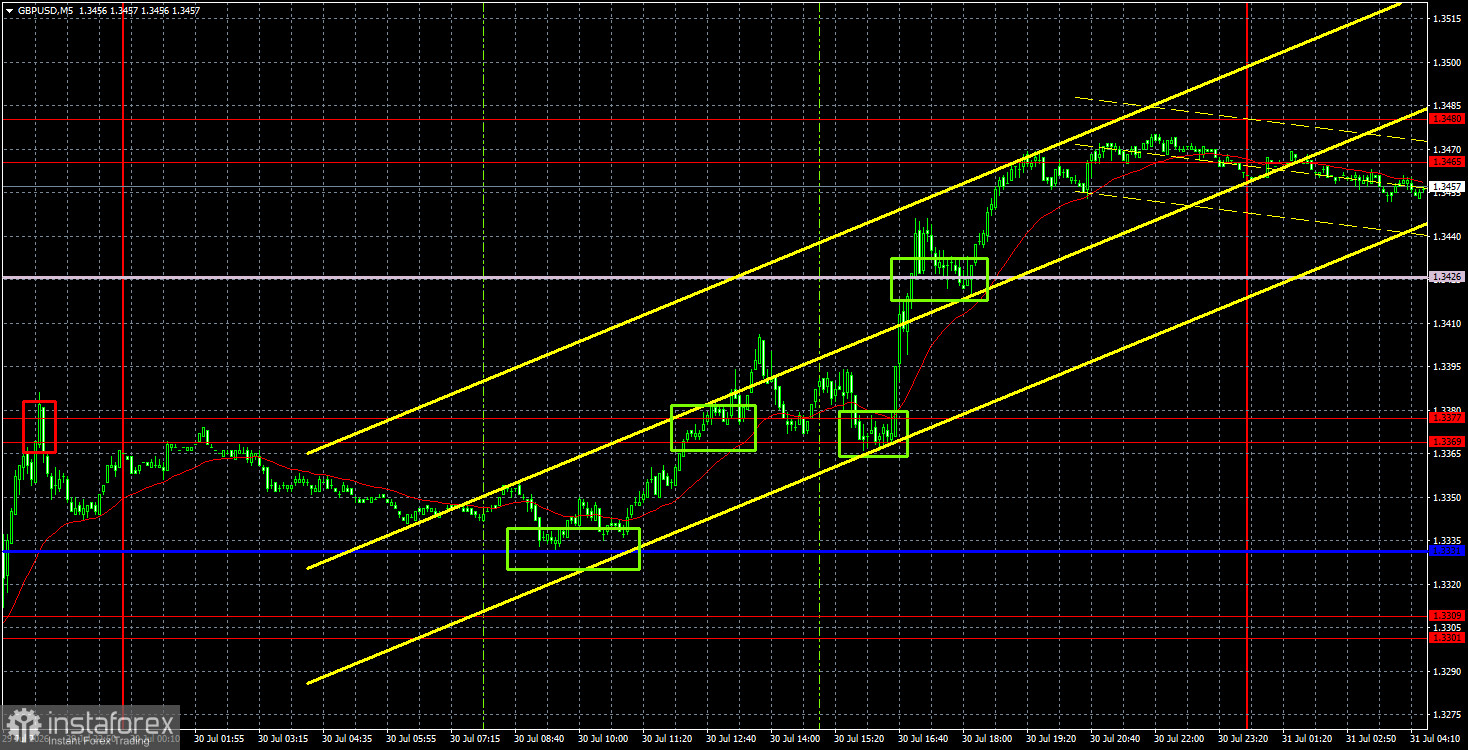
The GBP/USD currency pair continued its strong upward movement throughout Thursday, reaching the 1.3465-1.3480 area by the end of the day. While the growth of the British pound on Wednesday evening was driven by the FOMC meeting, Thursday's rise was influenced by the disappointing US GDP report for the second quarter and a more hawkish stance from the Bank of England than expected. Despite UK inflation dropping to 2.6% in June, the BoE still anticipates an acceleration, which may prompt a rate hike in the second half of 2026. Yesterday, three members of the Monetary Committee voted for policy tightening. As a result, the market was forced to shift its optimism from the Federal Reserve to the BoE. The US economy is slowing again, and if the Fed begins raising rates, it will decelerate further and drag down the labor market, which has not shown encouraging job creation in recent months. In contrast, the BoE is not burdened by GDP figures or by Donald Trump, who continues to demand a rate cut. Therefore, even the BoE is more likely to tighten than the Fed.
From a technical perspective, the British pound broke the descending trend line and began to form an upward trend. It is important to note that, in the long term, the pound is also in a flat range, which is clearly visible on the weekly time frame. After testing the lower boundary of the sideways channel, a logical movement toward the upper boundary has commenced, which is not yet complete.
On the 5-minute time frame on Thursday, four buy signals were generated. First, the pair bounced off the critical line, then broke through and bounced off the area of 1.3369-1.3377, and finally, it overcame the Senkou Span B line. Thus, traders could open a long position and then secure profits in the 1.3465-1.3480 area.
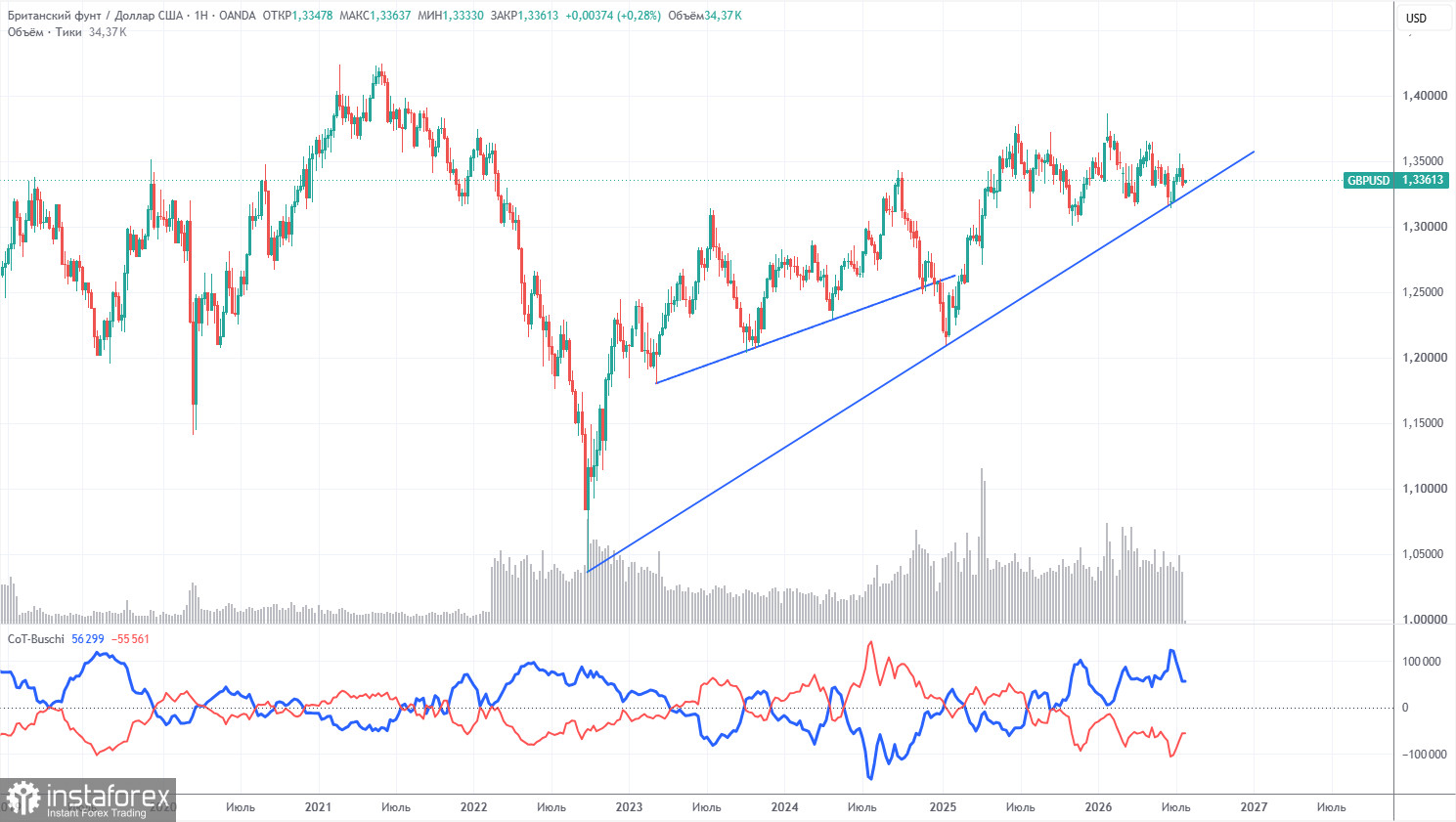
COT reports for the British pound indicate that non-commercial traders have dominated the market with sales for several consecutive months. The net position remains negative despite the ongoing long-term upward trend. Given the situation in the Middle East, it is not surprising that demand for risk currencies remains weak. The war is formally over, but the conflict persists. Geopolitics may continue to support demand for the US dollar in the near future. However, we would not expect a significant decline in the pair unless it consolidates below the trend line.
In the long term, the dollar is expected to continue its decline due to Trump's policies, as is clearly shown on the weekly time frame (illustration above). The trade war will continue in one form or another for a long time, and Trump's policies are aimed, both directly and indirectly, at weakening the American currency. The long-term upward trend remains intact, as evidenced by the trend line. The price has recently tested this line and bounced off it. According to the latest COT report (dated July 21), the "Non-commercial" group opened 13,200 BUY contracts and closed 2,500 SELL contracts. Thus, the net position of non-commercial traders increased by 15,500 contracts over the week.
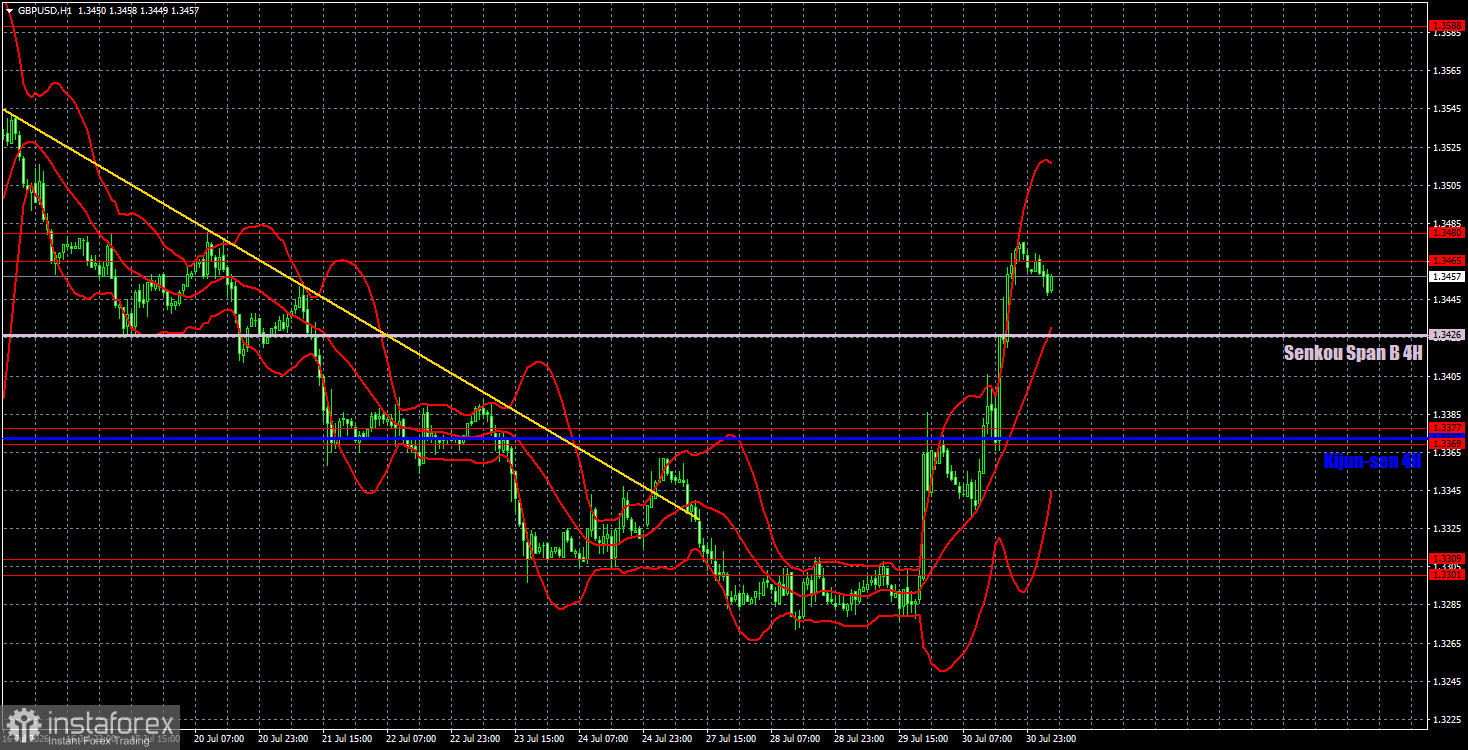
On the hourly time frame, the GBP/USD pair has begun forming an upward trend, thanks to the BoE and the Fed. In the long term, both European currencies still show an upward movement and have been trading within sideways channels for a full year. However, this does not negate the upward trend that began back in 2022. We expect the British pound to continue rising in the coming weeks, regardless of geopolitical factors or economic conditions.
For July 31, we highlight the following important levels: 1.3042-1.3050, 1.3096-1.3115, 1.3179-1.3187, 1.3301-1.3309, 1.3369-1.3377, 1.3465-1.3480, 1.3588, 1.3671-1.3681. The Senkou Span B line (1.3426) and the Kijun-sen line (1.3371) may also provide signal sources. It is recommended to set a Stop Loss at breakeven when the price moves in the right direction by 20 pips. The Ichimoku indicator lines may shift throughout the day, which should be taken into account when determining trading signals.
On Friday, there are no significant events planned in the UK, while the US has only secondary reports scheduled. Thus, the macroeconomic and fundamental background will be lacking today, and volatility is likely to decrease.
Today, traders may open short positions targeting 1.3426 and the 1.3369-1.3377 area, as the price has bounced off the 1.3465-1.3480 area. Long positions can be opened if the price consolidates above the 1.3465-1.3480 area, targeting 1.3588, or if there is a bounce off the Senkou Span B line.


