
Vea también


 08.10.2026 09:12 AM
Yesterday, the market was shaken by news that advances in AI could accelerate the discovery of mathematical vulnerabilities in crypto wallets.
Ethereum co-founder Vitalik Buterin warned that AI could speed up mathematical research and put the cryptography that underpins the security of Bitcoin, Ethereum, and other networks at risk. That warning came against the backdrop of yesterday's market decline.

The essence of the warning is this. According to Buterin, there is a "good chance" that AI, by accelerating mathematical research, will significantly weaken cryptography within two years. Buterin warned that the ECDSA digital signature algorithm underpinning Bitcoin and Ethereum wallets could become vulnerable much sooner than expected, potentially even before practical quantum computers emerge. The prompt for his remarks was new results in mathematics: OpenAI recently published several hundred papers generated by an internal model. Buterin allows that over the next two years AI could advance mathematics as much as it has over the past 50 years.
He offered three recommendations. First: where possible, keep cryptocurrency on addresses that have never made outgoing transactions. The reason is that such an address has not yet revealed its public key, and an attacker has less information to work with. Second: do not expose signatures of multisig wallet participants on-chain and rotate keys after each operation, signing off-chain when possible. Third: prefer hash-based cryptography, which, in his view, is potentially more resilient to new attack methods.
Buterin argued that hashes lack the mathematical structure an AI could exploit, unlike elliptic curves and lattices, and said this is why Ethereum's Lean roadmap has been moving toward hash-based signatures such as WOTS and SPHINCS+ over roughly the past year.
At the same time Buterin urged calm. He admitted that he personally has lost more money to mistakes when moving assets than to all hacks combined. Incidentally, yesterday Ledger's CTO also warned that a hasty mass migration would likely cause losses from user errors rather than protect against the AI threat. However, these are longer-term risks. In the coming days, the prices of Bitcoin and Ethereum will be driven not by cryptography but by bond yields, oil, and Fed rate expectations.
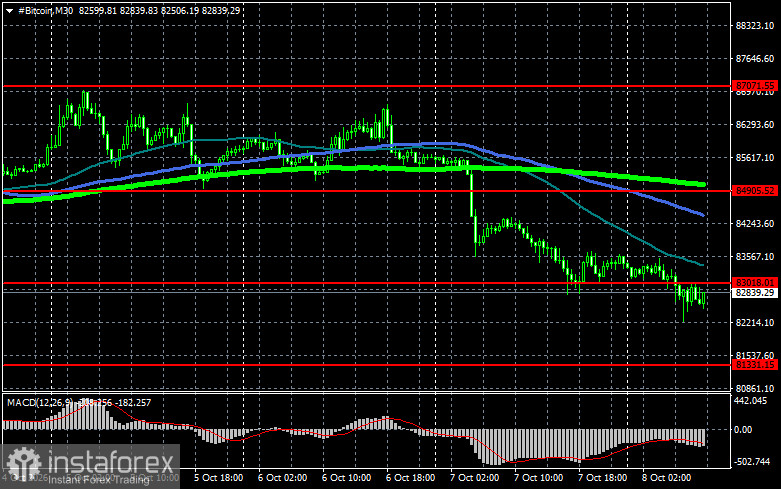
A technical picture for Bitcoin suggests that buyers are currently targeting a reclaim of $83,000, which would open a direct path to $84,900 and then to $87,000, where breaking through would signal attempts to restore a bull market. In case of a decline, buyers are expected at $81,300. A return of the instrument below that area could quickly push BTC toward $79,400. The most distant target would be the $78,100 area.
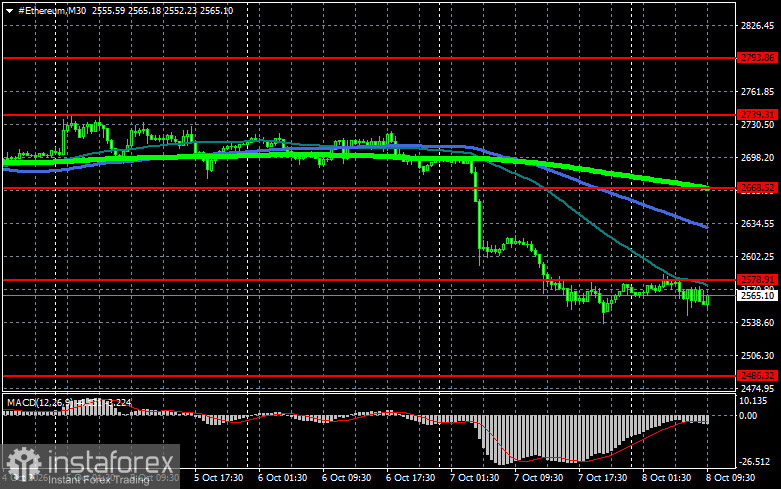
A technical picture for Ethereum shows a clear hold above $2,578 would open a direct path to $2,668. The furthest target is the high near $2,739; breaking that level would indicate strengthening bullish sentiment and a return of buyer interest. In case of a drop, buyers are expected at $2,486. A return of the trading instrument below that area could quickly push ETH toward $2,433. The most distant target would be the $2,367 area.
What we see on the chart:
- Red lines indicate support and resistance levels where either a price slowdown or active growth is expected;
- Green lines indicate the 50-day moving average;
- Blue lines indicate the 100-day moving average;
- Light green lines indicate the 200-day moving average.
A crossover, or a price test of moving averages, typically either halts the move or sparks fresh market momentum.


