
Vea también


 23.06.2026 10:13 AM
Yesterday, Chicago Fed President Austan Goolsbee added weight to the Fed's hawkish camp, openly doubting that the current surge in inflation is merely temporary. "We are facing an inflation problem that is well above the target and is moving in the wrong direction," he said in a Monday interview.
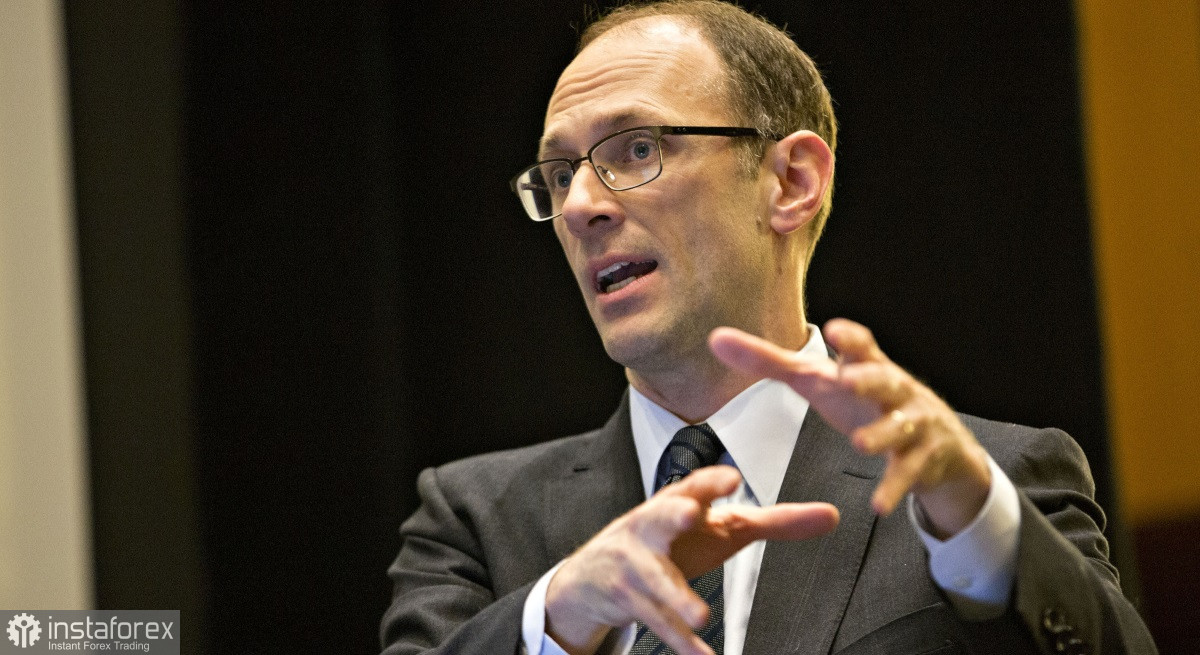
The key point of his remarks was the nature of inflation. Goolsbee says the Federal Reserve must determine precisely whether only temporary shocks — such as tariffs and war-driven higher energy prices — are pushing prices up. Incidentally, for the same reason, the European Central Bank recently raised interest rates.
He is particularly worried about rising services inflation that is not directly linked to those shocks. As he noted, services inflation is often the most persistent because it is tied to wages rather than commodity swings. It appears that the risk of second-round effects is becoming a shared concern for central banks on both sides of the Atlantic.
The context of Goolsbee's remarks strengthens his signal. Last week, the Fed left the key interest rate unchanged, but updated forecasts showed that nearly half of FOMC members expect at least one rate hike this year. Inflation has missed the 2% target for more than five years and accelerated in May to a three-plus-year high after the war in Iran pushed energy prices up and offset US wage gains. The longer this pressure persists, the louder the voices arguing that current rate levels are insufficient will become.
Goolsbee's stance on the Fed's new operating style deserves special attention. He backed Kevin Warsh's approach of reducing the amount of forward guidance on the path of interest rates, arguing that incorrect forecasts about the economy can undermine confidence in the regulator. This is a fundamental shift in the Fed's communications philosophy. Warsh's first policy meeting last week already followed this tone, and the new chair announced the creation of five working groups on key policy areas, including communications and the balance sheet.
For the dollar, this is supportive; for risk assets, it is a major problem. This week, the PCE index — the Fed's preferred inflation gauge — will be released; an acceleration would only vindicate Goolsbee and like-minded committee members.
Technical outlook for EUR/USD
Buyers now need to secure the 1.1450 level. Only that would allow a test of 1.1480. From there, a move to 1.1530 is possible, though doing so without support from large players would be difficult. If the currency pair falls, I expect significant buying interest around 1.1420. If no buyers appear there, it would be better to wait for a new low at 1.1380 or to open long positions from 1.1345.
Technical outlook for GBP/USD
Pound buyers need to take the immediate resistance at 1.3270. Only that would open a path to 1.3300, above which breaking through will be quite difficult. The farther target is around 1.3325. On the downside, bears will try to seize control of 1.3225. If they do, a range break would deal a serious blow to bulls and push GBP/USD down to about 1.3180, with a potential extension to 1.3140.


