
یہ بھی دیکھیں


 07.10.2026 08:57 AM
Bitcoin plunged from $86,000 to $83,500 during Asian trading today and now trades around $84,000, down about 2.9% for the week. Liquidations amplified the move: roughly $360m of long leveraged positions were wiped out in about ten minutes. Price failed to hold above $86,000 after two consecutive corrective days, while the backdrop remains high 10-year Treasury yields and a strong dollar.

Against that backdrop, the market again looks to the November 3 midterms, and participants' expectations diverge. One narrative points out that in 2014, 2018, and 2022 the vote coincided with Bitcoin moving into a downtrend. In 2014, BTC declined from about $480 in summer to $330 on election day, then fell to $180 in January 2015. In 2018, it traded in a $6k–$6.5k range but lost 45.5% in the month after the vote. In 2022, BTC was around $20,500 before the election and dropped to $15,500 in November — roughly a 25% decline.
The other side looks more optimistic. CryptoQuant data show that in the 12 months following the 2014, 2018, and 2022 midterms, Bitcoin rose 24.5%, 44.9%, and 92.3%, respectively. So after the initial post-vote drop in 2018, the market was nearly 45% higher a year later. A similar seasonality exists in equities: since 1950, the S&P 500 rose in all 19 cases in the year after midterms, averaging +15.4%. Winners in this scenario are buyers who buy the post-vote dip; losers are leveraged traders who get squeezed on the first retracement — like today's $360m long squeeze.
I would not treat this as a law. CryptoQuant itself stresses that three observations do not prove a causal link between midterms and Bitcoin gains, and price and active addresses do not always move together. Removing political uncertainty can support the market, and the third year of a presidential term has historically been the strongest, but sustained upside needs supportive conditions: falling yields, ETF inflows and regulatory improvements.
My base scenario is two-step. Before the vote, I allow for continued correction and further tests of support: the market is very yield-sensitive, and the Federal Reserve minutes for September are due today. After the vote, I see a greater chance of recovery than of deeper decline, because history points to strong one-year dynamics and ETF demand structure differs from 2018 and 2022.
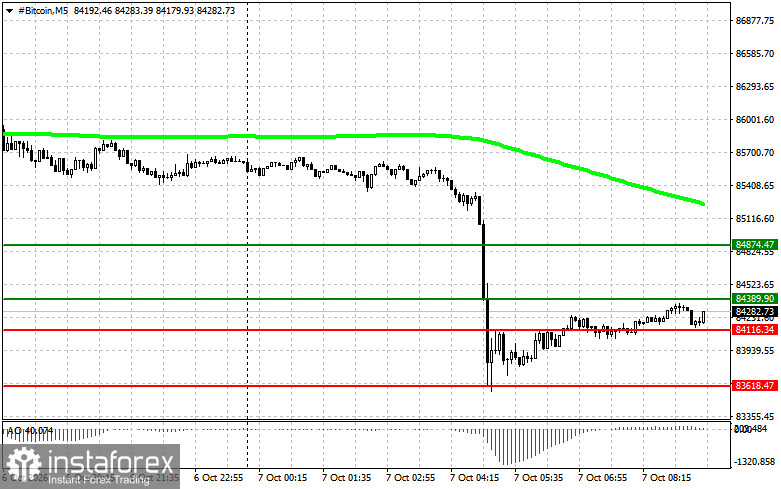
For Bitcoin, the price trades in a narrow range between support at 84,100 and resistance at 84,400, with outer boundaries at 83,600 and 84,800, and the plan is built around two mirrored directions with a full set of breakout and rejection scenarios. There are two entries for buying. First: a confirmed breakout of 84,400 to the upside — buy targeting 84,800, where I take profit and consider a short on the pullback, provided price is above the 50-day moving average and the Awesome Oscillator is above zero. Second: a rejection off 84,100 if the downside breakout fails and the spike proves false — buy for a return first to 84,400 and then to 84,800.
Sales are symmetric. On a confirmed breakdown of 84,100 to the downside, consider a short targeting 83,600, provided the moving average is above price, and the Awesome is below zero. If an upside breakout of 84,400 fails and price returns below that level, short from resistance aiming back to 84,100 and then 83,600.
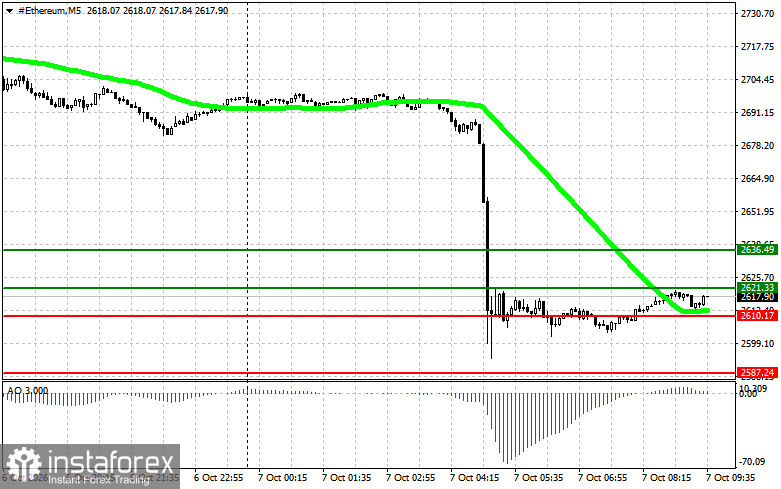
For Ether, the logic fully mirrors Bitcoin on its own price scale: the inner range is between support 2,610 and resistance 2,621, with outer boundaries at 2,587 and 2,636. Buy on a confirmed breakout above 2,621, targeting 2,636, where profit is taken and a short on the pullback may be considered; conditions are the same—price above the 50-day MA and Awesome above zero. Buy on a rejection from 2,610; if the downside breakout fails, initially toward 2,621 and then 2,636.
For selling, a confirmed breakdown of 2,610 opens a short targeting 2,587, provided the MA is above price and Awesome is below zero. A rejection from 2,621, if the upside breakout fails, gives a short for a return to 2,610 and then 2,587. Both indicators filter out false moves, not as standalone reasons to enter early, and trades are taken only after price confirms the specified levels.


