
Lihat juga


 31.07.2026 12:54 AM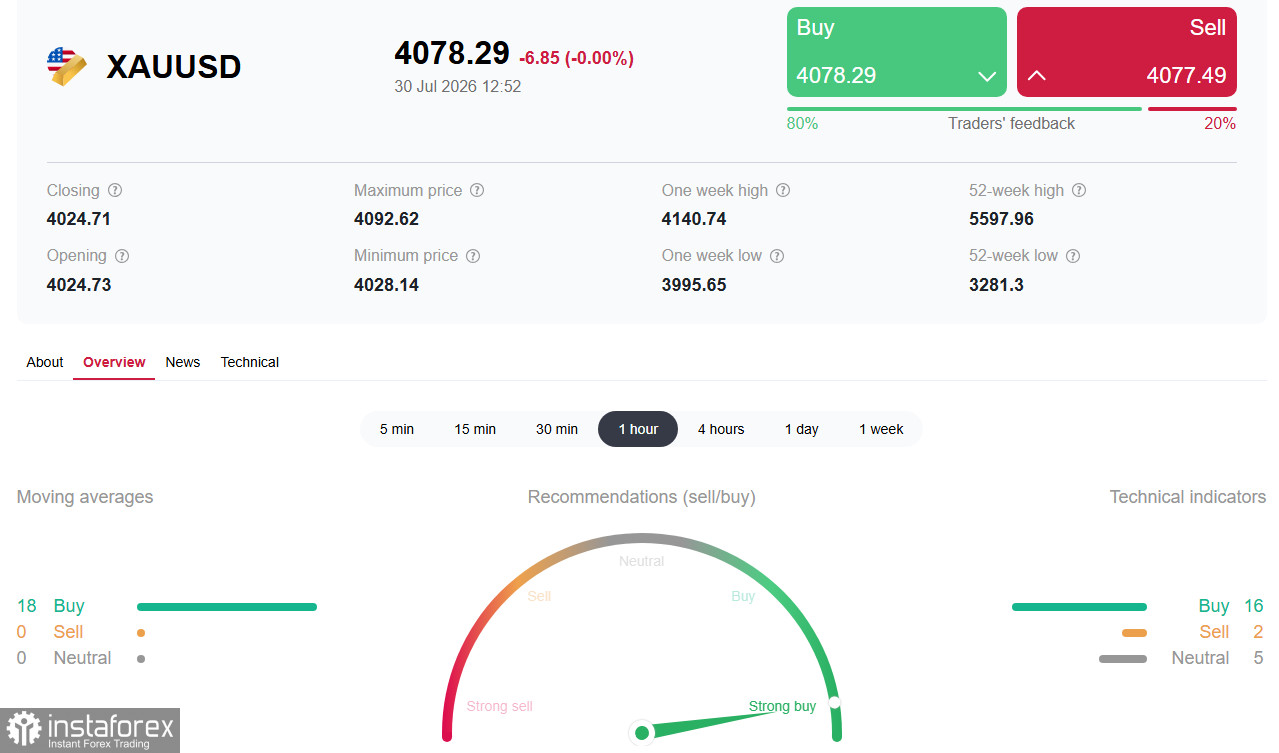
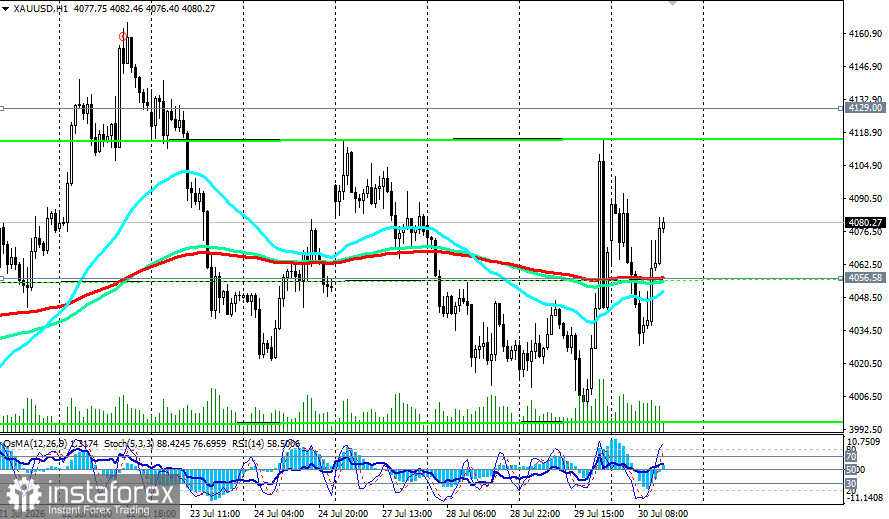
As of the beginning of the American session on Thursday, July 30, XAU/USD is trading around 4076.00, retreating from the weekly high of around 4100.00 reached the day before. The market is holding steady in anticipation of two key events: the release of preliminary data on US GDP for the second quarter and the Personal Consumption Expenditures (PCE) price index — the Fed's preferred measure of inflation.
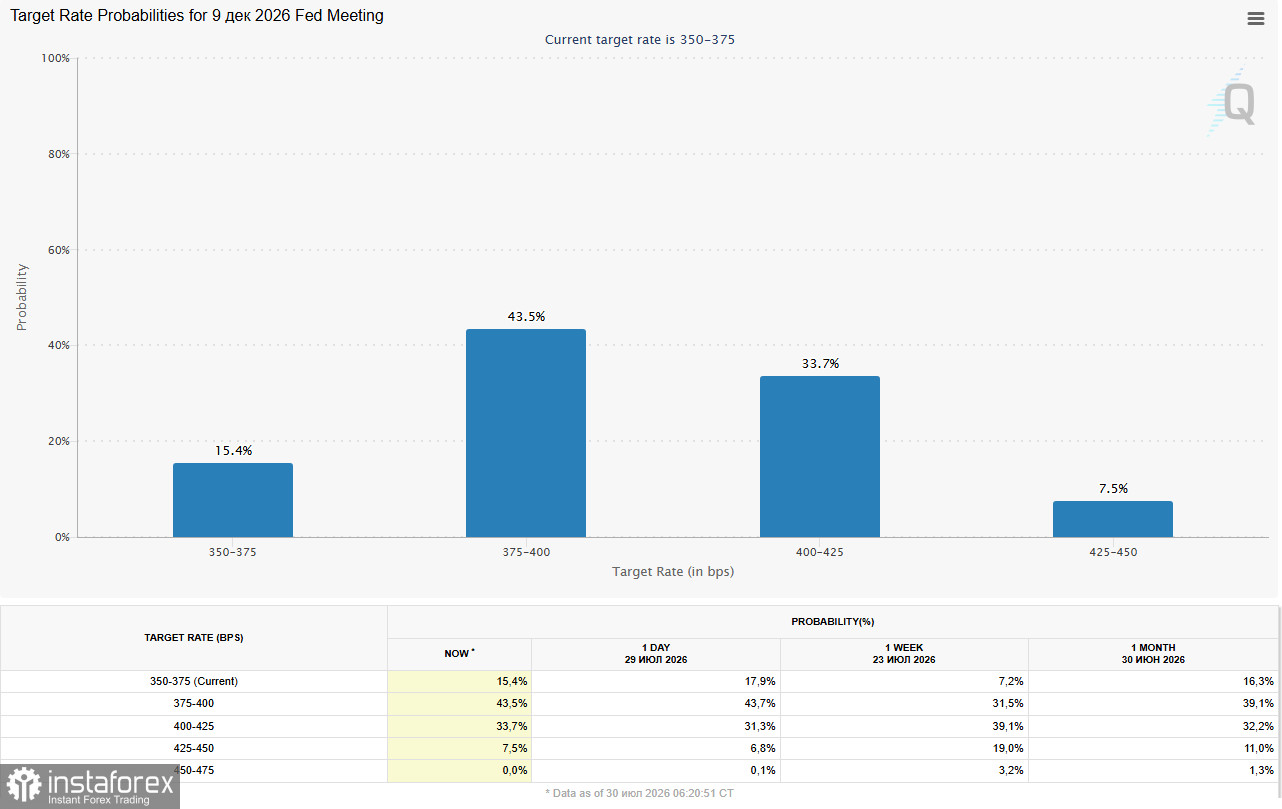
The degree of uncertainty surrounding the future trajectory of monetary policy remains high. According to the CME FedWatch tool, markets are pricing in about a 35% probability that the Fed will maintain its current rate at the September meeting, while the likelihood of tightening by the end of the year is estimated at approximately 85%.
However, three FOMC members (Beth Hammack, Neel Kashkari, and Lori Logan) voted for a 25-basis-point increase, marking the most significant division since 2016. The new Fed Chair, Kevin Waller, confirmed the commitment to achieving the 2% inflation target during the press conference but refrained from providing clear signals about the future trajectory of interest rates.
The renewed geopolitical tensions in the Middle East also heighten pressure on gold. Late Wednesday, American military forces struck Iran in response to Iranian missile attacks on US forces in the region. Iranian media reported strikes against the city of Abadan and Qeshm Island. This has restored the geopolitical premium in energy prices and strengthened demand for the dollar as a "safe haven," further pressuring gold.
The key factor determining gold's dynamics remains the balance between inflation risks from rising energy prices and expectations of future Fed policy easing. On one hand, the escalation of the conflict in the Persian Gulf and the ongoing blockade of the Strait of Hormuz (through which about 25% of maritime oil supplies typically pass) keep energy prices elevated, intensifying inflation expectations and arguments for Fed tightening. On the other hand, a slowdown in economic growth (with US GDP expected to remain at around 2.1% year-on-year) and signs of a cooling labor market may incline the Fed to soften its rhetoric in the second half of the year.
As economists note, in the short term, rising energy prices can put pressure on gold through a stronger dollar and higher real yields. However, in the medium and long term, structural factors—continued central bank purchases of gold (with net purchases of 244 tons in Q1 2026), de-dollarization of reserves, and rising national debt—provide solid support for the precious metal.
If it becomes clear that current inflationary pressures do not trigger widespread secondary effects, the Fed may adopt a more moderate stance, which could serve as an important catalyst for a recovery in gold prices, according to economists. UBS's baseline forecast anticipates gold rising to $5,500 per ounce by the end of the year.
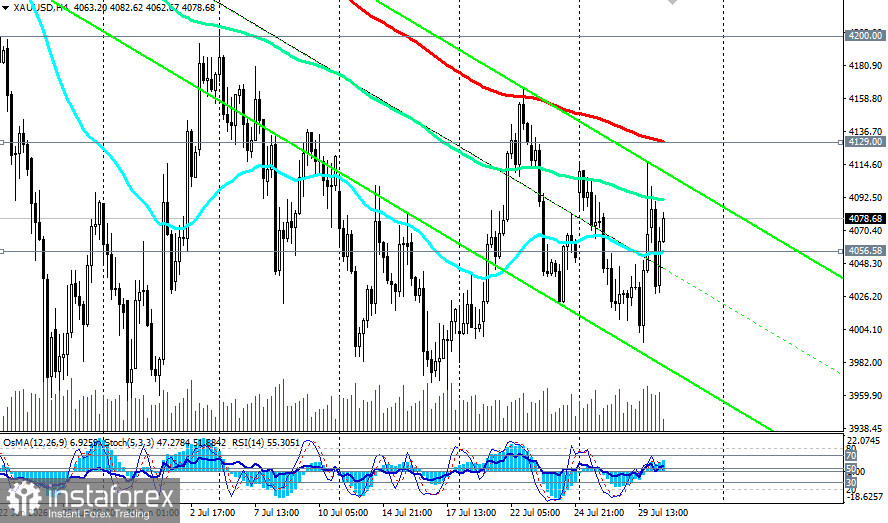
From a technical perspective, XAU/USD maintains a bearish bias, consolidating below key daily moving averages—EMA50 (4200.00), EMA200 (4290.00), and EMA144 (4350.00)—while moving within descending channels on the 4-hour and weekly charts. Since the beginning of the week, gold has attempted to establish itself above the $4100.00 level four times, but each time it faced a pullback.
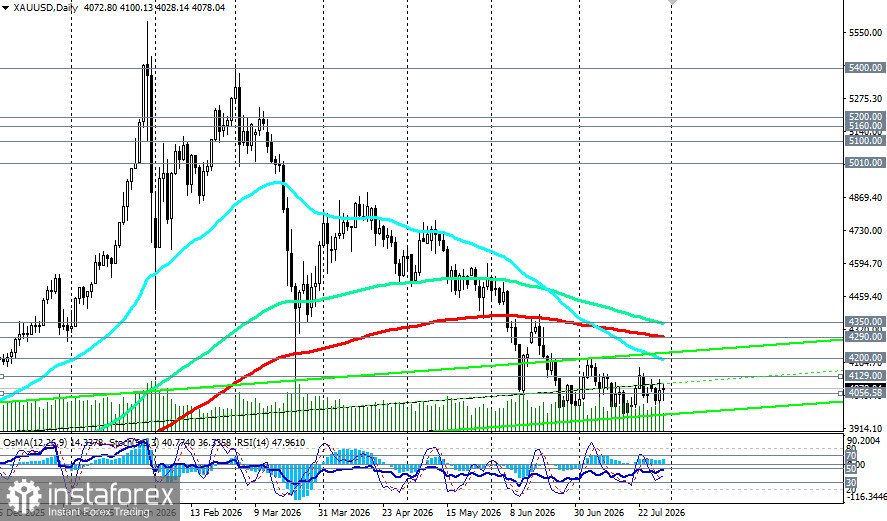
If the price breaks below the range of 4200.00-3965.00, it will likely start a deeper correction toward the levels of 3900.00-3850.00, where the lower boundary of the aforementioned descending channel on the weekly chart lies. At the same time, if signs of Fed policy easing emerge, the price may attempt an upward breakout, with the nearest target at 4200.00.
Date | Event | Forecast / Expectation | Expected Impact on XAU/USD |
|---|---|---|---|
July 30, 12:30 GMT | Preliminary US GDP data for Q2 | Expected growth of 2.1% year-on-year | Strong data = pressure on gold; weak = support |
July 30, 12:30 GMT | PCE inflation data (June) | Forecast: slowdown of core PCE to 0.2% MoM | Weak data = rise in gold; strong = pressure |
July 30, 12:30 GMT | Initial jobless claims data | Forecast: 200-204K | Rise in claims = support for gold |
July 31, 05:00 GMT | Bank of Japan meeting | Expected to keep rates at 1.00% | Indirect impact through USD/JPY dynamics |
Ongoing | Geopolitical situation in the Middle East | High uncertainty | Escalation = strengthening USD (pressure on gold); de-escalation = support for gold |
The XAU/USD pair is in a crucial phase where structural demand for gold from central banks and concerns about de-dollarization collide with short-term risks of tighter Fed policy and a strengthening dollar. The key range of 4129.00-3965.00 remains the primary watershed for short-term dynamics. This week, market attention will focus on US GDP and PCE inflation data, as well as developments in the geopolitical situation, which may provide new signals for future movements.
The spread of forecasts from leading banks (over $1400.00) reflects the high uncertainty regarding the future trajectory of the Fed's monetary policy and geopolitical developments:
For Short-Term Traders: The priority is to buy from the support level of $4000.00 with targets at $4100.00–$4200.00. Short positions should only be considered upon a breakout below $3965.00, confirmed by fundamental factors.
For Medium-Term Investors: Adopt a wait-and-see approach until the geopolitical situation and Fed signals clarify. A potential correction to $3965.00–$4000.00 could be used to build long positions, considering structural support from central banks.
Risk Management: Exercise caution due to high volatility related to geopolitical events, central bank decisions, and macroeconomic data releases. Strictly adhere to stop-loss orders and monitor developments in the Middle East as well as comments from Fed representatives.


