
Veja também


 13.08.2026 01:39 PM
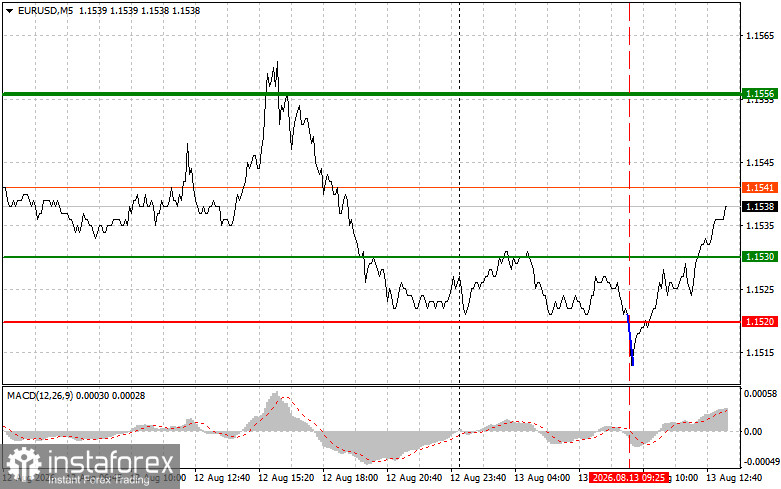
The test of 1.1520 occurred when the MACD indicator had just started moving down from the zero line, confirming that the entry point for a short position was appropriate. As a result, the pair declined by only 10 points.
The weak industrial data put pressure on the single currency, which reacted with a moderate decline. Eurozone production showed no growth in June, remaining unchanged at zero. Since industrial production is an important indicator of the real sector, its stagnation increased doubts about the sustainability of the bloc's economy and removed a potential driver for the euro's growth. For EUR/USD, this means there is no clear driver, and the pair's dynamics remain dependent on the dollar's performance.
In the second half of the day, the pair will remain focused on U.S. inflation data, which could change the balance of power. The Producer Price Index and its core reading, excluding food and energy, will be released, along with weekly initial jobless claims. The Producer Price Index is important because it can provide an early indication of consumer inflation and therefore directly affect expectations for the Federal Reserve's interest rate policy, while jobless claims reflect the state of the labor market. For the single currency, the implications are straightforward. If producer prices rise, demand for the dollar will quickly return, putting pressure on EUR/USD, while a slowdown in inflation would favor the euro.
As for the intraday strategy, I will rely more heavily on the implementation of Scenarios #1 and #2.
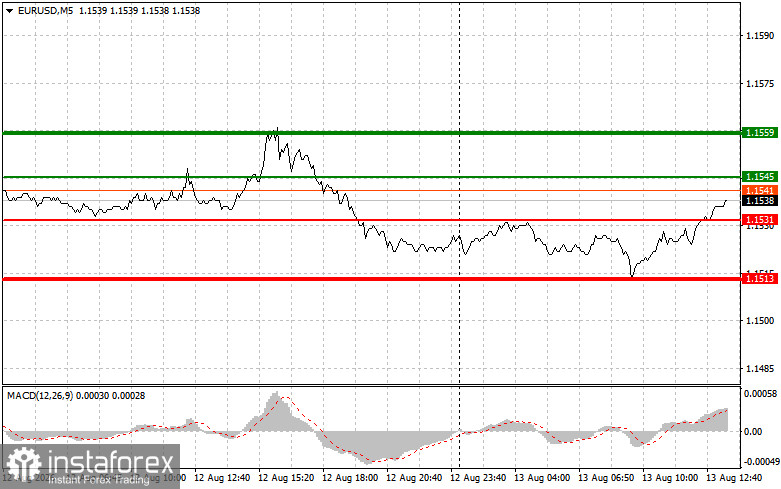
Scenario #1: Today, the euro can be bought when the price reaches around 1.1545 (the green line on the chart), with a target of 1.1559. At 1.1559, I plan to exit the market and also sell the euro in the opposite direction, targeting a move of 30–35 points from the entry point. The euro can be expected to rise today only if U.S. data are weak. Important! Before buying, make sure that the MACD indicator is above the zero line and has just begun rising from it.
Scenario #2: Today, I also plan to buy the euro if the price tests 1.1531 twice consecutively while the MACD indicator is in the oversold zone. This will limit the pair's downward potential and lead to an upward reversal. A rise toward the opposite levels of 1.1545 and 1.1559 can be expected.
Scenario #1: I plan to sell the euro after the price reaches 1.1531 (the red line on the chart). The target will be 1.1513, where I plan to exit the market and immediately buy in the opposite direction, targeting a 20–25-point move in the opposite direction from the level. Downward pressure on the pair will return if the data are strong. Important! Before selling, make sure that the MACD indicator is below the zero line and has just begun declining from it.
Scenario #2: Today, I also plan to sell the euro if the price tests 1.1545 twice consecutively while the MACD indicator is in the overbought zone. This will limit the pair's upward potential and lead to a downward reversal. A decline toward the opposite levels of 1.1531 and 1.1513 can be expected.
Important. Beginner Forex traders should exercise great caution when making decisions about entering the market. Before the release of important fundamental reports, it is best to stay out of the market to avoid being caught in sharp price fluctuations. If you decide to trade during a news release, always place stop orders to minimize losses. Without stop orders, you can lose your entire trading account very quickly, especially if you do not use proper money management and trade large volumes.
And remember that successful trading requires a clear trading plan, such as the one presented above. Making spontaneous trading decisions based on the current market situation is inherently a losing strategy for an intraday trader.


