
یہ بھی دیکھیں


 22.06.2026 12:50 AM
Traders had a tough week. Last week, the European currency lost nearly 200 basis points in just a couple of days, but that's not the main point. What matters is that until Saturday, it was unclear what exactly caused the significant strengthening of the U.S. dollar and the decline of the euro. At first glance, it seems obvious. The FOMC meeting concluded with a slightly more hawkish tone than the market anticipated. I view it as "slightly more hawkish." Recall that the market had expected one round of monetary policy tightening by the end of the prior year, before the Federal Reserve meeting. The meeting took place, and half of the FOMC committee projected one rate hike by the end of the year. Consequently, the question arises: what triggered such a sharp rise in the U.S. dollar if the expectations aligned with reality?
I agree that six committee members anticipated two or more tightenings. However, 12 FOMC members did not support this scenario, and, more importantly, this was the central bank's stance as of June. The Fed does not plan to raise rates in July, and by September, the situation with inflation and the war in the Middle East could change several times. Therefore, with all due respect to the Fed, FOMC officials, and the market, I see no strong reasons for such a rapid rise in the dollar.
However, this strong rise in the dollar has complicated the bearish structure and elongated it. On a broader scale, the presumed wave C continues to form and should assume an elongated shape and complete its structure below the 14 figure. Thus, in part, everything is logical.
Next week, a few interesting reports will come out in the Eurozone, but I believe they will remain secondary for market participants. I will note the business activity indices in Germany and the Eurozone on Monday, but that's all my readers can focus on. Therefore, even after the signing of the deal between Iran and the U.S., geopolitics will still take precedence. Moreover, it seems that this factor precisely caused the sharp strengthening of the U.S. dollar, rather than the FOMC meeting.
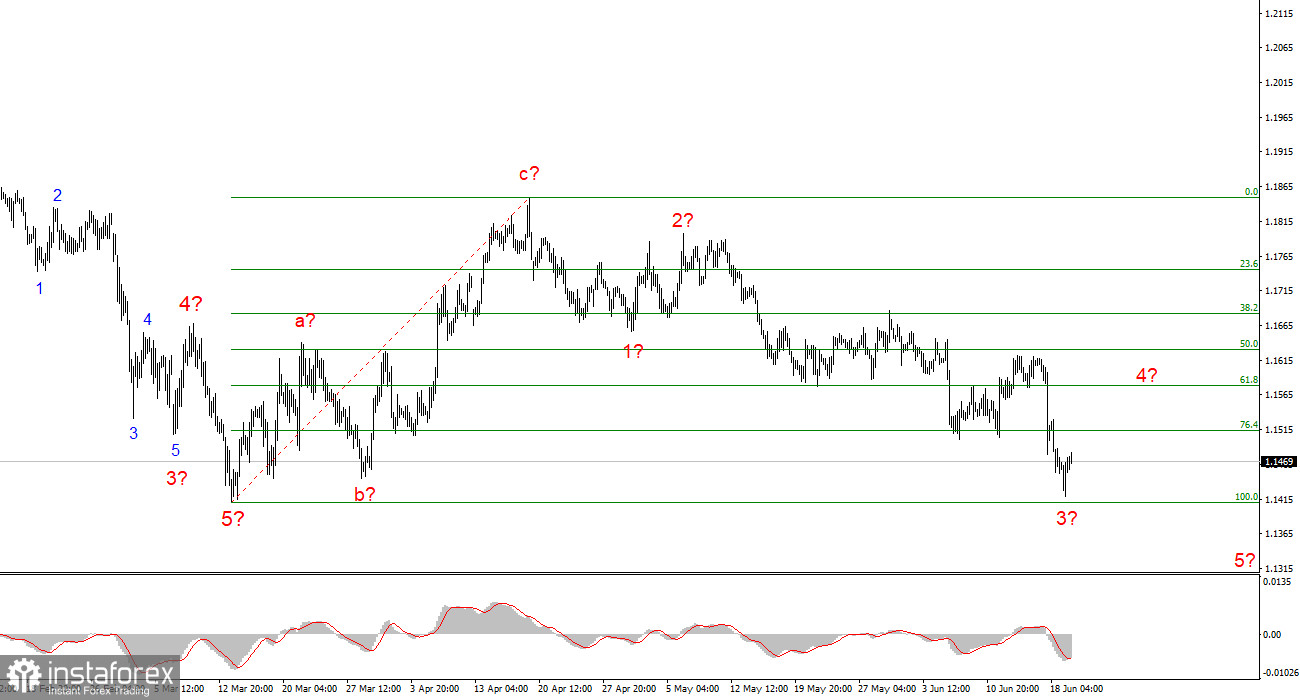
Based on the analysis of EUR/USD, I conclude that the instrument remains within an upward segment of the trend (bottom chart), while in the shorter term, it is within a downward segment that may be nearing completion. In my view, it is a good time to consider forming long positions, but the instrument may dip below the 14 figure within wave C. If this assumption holds, it would be better to wait a little longer. I believe the market will also take into account that the European Central Bank is tightening and that the geopolitical conflict between Iran and the U.S. may soon come to an end.
The wave structure for GBP/USD has become clearer. Currently, the instrument has formed three waves down, while EUR/USD has formed five. Consequently, the British pound may limit itself to forming a corrective structure, and both currency pairs could begin to establish upward segments of the trend. At the moment, this is just an assumption, but it is a probable one. If it proves correct, the instrument will start to rise, with targets around the 35 level and above. Market participants currently have a good opportunity to buy.


