
Lihat juga


 23.09.2026 07:58 AM
The dollar resumed steady gains after three Federal Reserve officials signaled that the tightening cycle is probably not over. The euro and the pound lost ground in lockstep against the U.S. currency, effectively losing their own directional anchors.

Richmond Fed president Tom Barkin warned that inflationary shocks may take time to dissipate fully and did not rule out the risk of elevated inflation becoming persistent. Boston Fed president Susan Collins was even clearer, saying she is among those on the committee who factor in one more rate hike before year-end. New York Fed president John Williams focused on technical issues, noting that the transition of Treasury and repo markets to centralized clearing is progressing ahead of schedule and reaffirming the Fed's commitment to manage bank reserves flexibly. Formally, none of the three have votes this year, but their combined messaging significantly strengthened market expectations of further tightening. For EUR/USD and GBP/USD, this means continued pressure absent offsetting signals from the European Central Bank or Bank of England— both pairs will struggle to find reasons to recover in the near term.
This morning the euro area will publish preliminary September PMIs — manufacturing, services and composite. After August's readings (composite stable at 52.0, manufacturing peaking at 52.7 — the best since May 2022 — and services easing to 51.6), the market does not expect a repeat surge, but it also does not expect a sharp deterioration; the consensus is that activity will remain roughly at current levels. Even so, such stability is unlikely to strengthen the euro: the issue is not the quality of the prints but that markets are focused on Fed rhetoric, which, after a recent series of hawkish speeches, outweighs neutral European signals. Even confirmation of continued expansion is unlikely to offset dollar pressure; EUR/USD will probably move primarily to the U.S. agenda rather than its own stats.
For sterling, the key focus in the first half of the day will be the September PMI block for the UK — manufacturing, services and composite. Recall that August already painted a worrying picture: manufacturing slipped to a five-month low of 51.5, and only the services sector (up to 52.5) rescued the composite, masking manufacturing weakness. If today's prints continue the cooling trend — especially in manufacturing — that will be an additional burden on GBP/USD on top of the already difficult backdrop.
The logic is straightforward: weak PMIs are read as signs of slowing activity, and slowing activity reduces the case for BoE tightening, which is already not prominent. Sterling would then have no independent support to recover against the dollar, particularly given the intensifying hawkish signals from across the Atlantic. Weaker data would deepen the pair's descent, while unexpectedly strong PMI readings could at least provide a temporary pause for GBP/USD to stabilize — though there is no guarantee that pause would become a sustained reversal.
For the euro, the key upside pivot is 1.1423; a break above it could push the pair to 1.1454 and then 1.1478. That scenario is realistic only if PMIs come in materially stronger than the market expects — without such a surprise, it will be hard for the euro to sustain gains against the Fed's very hawkish stance. Far more workable in my view is a break below 1.1412, opening the road to 1.1392 and 1.1376, since the combined weight of yesterday's and today's signals favors the dollar.
For the pound, the upside pivot is 1.3341, which could take the pair to 1.3368 and then 1.3397, but without strong UK data, sterling has little on which to rally. A break below 1.3307 toward 1.3275 and 1.3243 looks much more logical given heightened Fed-rate expectations.
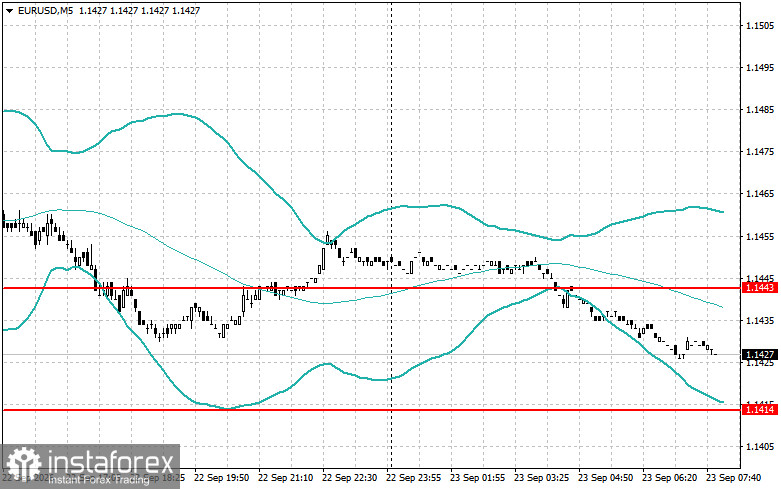
For the euro, I'm watching the upper boundary at 1.1443. The logic is simple: the pair pokes above, fails to find continuation buyers, and then slides back down — that gives a sell signal. After a series of hawkish Fed speeches, this scenario looks appropriate. The lower reference at 1.1414 works by the opposite logic, but buying there should be cautious: without a euro-area catalyst, a sustained rebound is unlikely, and targets for such a bounce should be modest.
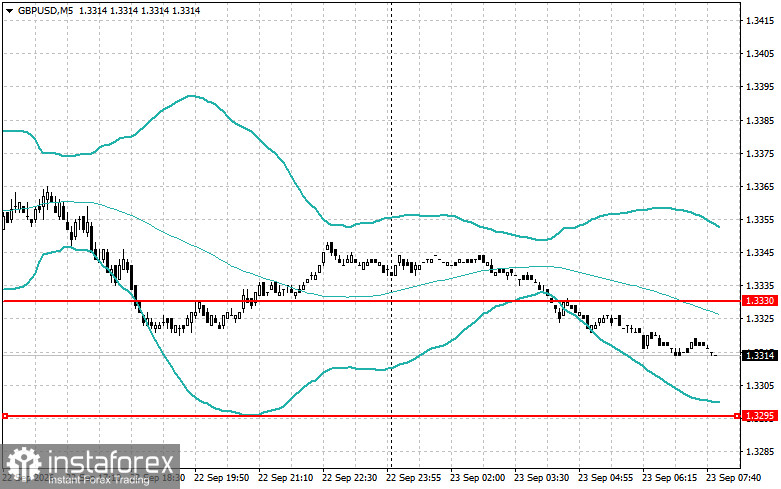
For the pound, the upper boundary is 1.3330. The same return logic applies, and given the complete absence of domestic drivers for sterling today, a false breakout above followed by a return inside the range is a likely scenario. The lower reference at 1.3295 implies buying on a rebound after a false downside break, but trade it cautiously — with Fed rhetoric so firm, even a successful technical bounce may be short-lived.


