
Lihat juga


 28.01.2026 07:58 PM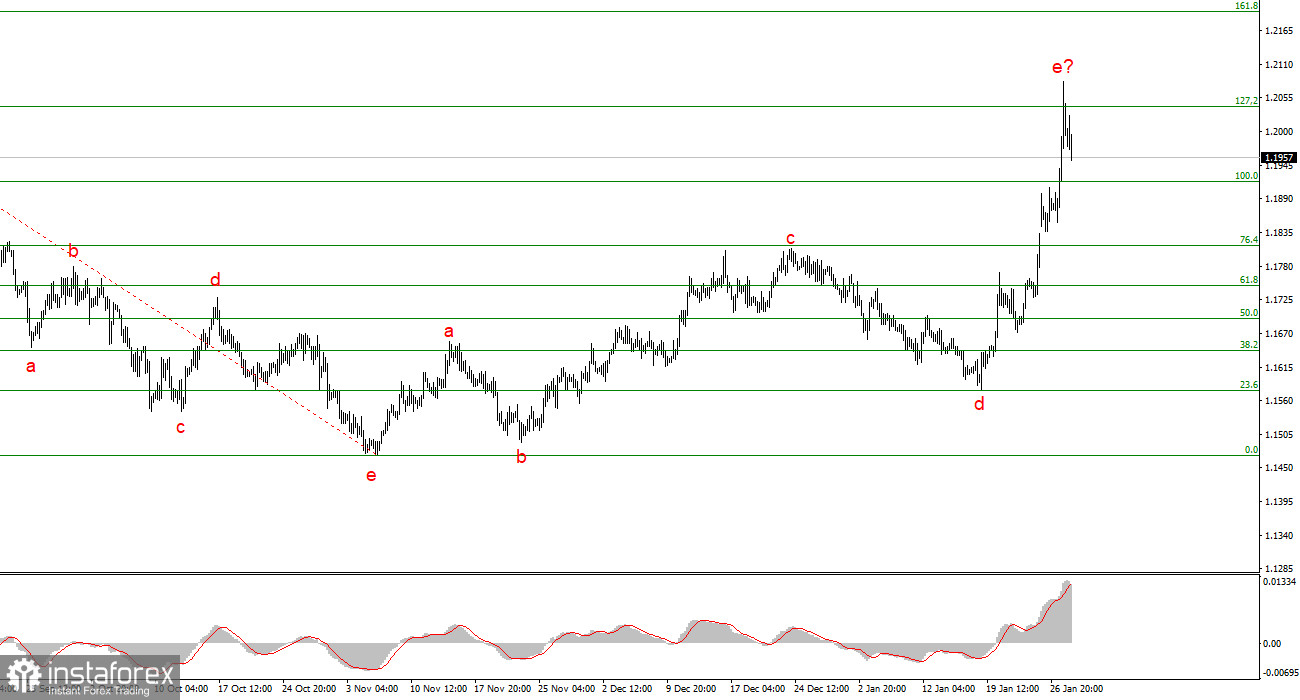
The wave count on the 4-hour chart for EUR/USD has undergone minor changes, but nothing fundamental has changed. There is still no talk of canceling the upward trend segment that began in January of last year; only the internal wave structure is periodically adjusted. In my view, the pair has completed the formation of the global corrective wave 4. If this assumption is correct, the formation of wave 5 has now begun and is ongoing, with targets extending as high as the 1.25 level.
The internal wave structure of the presumed wave 5 is not entirely straightforward. The upward wave sequence cannot be considered impulsive due to relatively strong corrective waves. Therefore, at the moment it is interpreted as an a–b–c–d–e structure. However, if wave 5 becomes extended, its internal structure will also be quite complex. As a result, we may currently be observing the formation of wave 3 of 3 of 5. In any case, I expect further growth in EUR/USD, although in the coming days the market may shift into the formation of a corrective wave—at least one.
The EUR/USD rate fell by 90 basis points on Wednesday and rose by 160 on Tuesday. This evening brings an FOMC meeting, while Trump is preparing to strike Iran. That is the brief news summary of the past 24 hours. To analyze all the news in detail would likely require five separate reviews, but let us try to fit it into one.
The latest collapse of the U.S. dollar began with the introduction of higher tariffs against Canada and South Korea. Then Donald Trump stated that the current dollar exchange rate—now at four-year lows—is "brilliant" for the U.S. economy. Today, Trump wrote on the social network Truth Social about an aircraft carrier strike group approaching the shores of Iran and urged Tehran to sit down at the negotiating table as soon as possible and reach a deal on the country's non-nuclear status. And, as already mentioned, the FOMC meeting takes place this evening, with its chairman currently under criminal investigation—also initiated by Trump. Incidentally, one of the FOMC members is also under legal investigation: Lisa Cook.
It is impossible to describe the current news background as favorable for the U.S. dollar. Donald Trump stated that the naval forces currently heading toward the Iranian region significantly exceed in strength those previously used during the strike on Venezuela. I would venture to assume that this carrier group is not heading toward Iran merely to remain off its shores. If an airstrike takes place, it could even be positive news for the dollar. Let me remind you that last summer, when strikes were carried out on Iran's nuclear facilities, demand for the U.S. dollar rose briefly. In addition, the current wave count suggests the formation of a corrective wave. Therefore, the market may take a pause in selling the U.S. currency for some time. No dovish decisions from the Fed are expected in the near future, so sellers may temporarily improve their position.
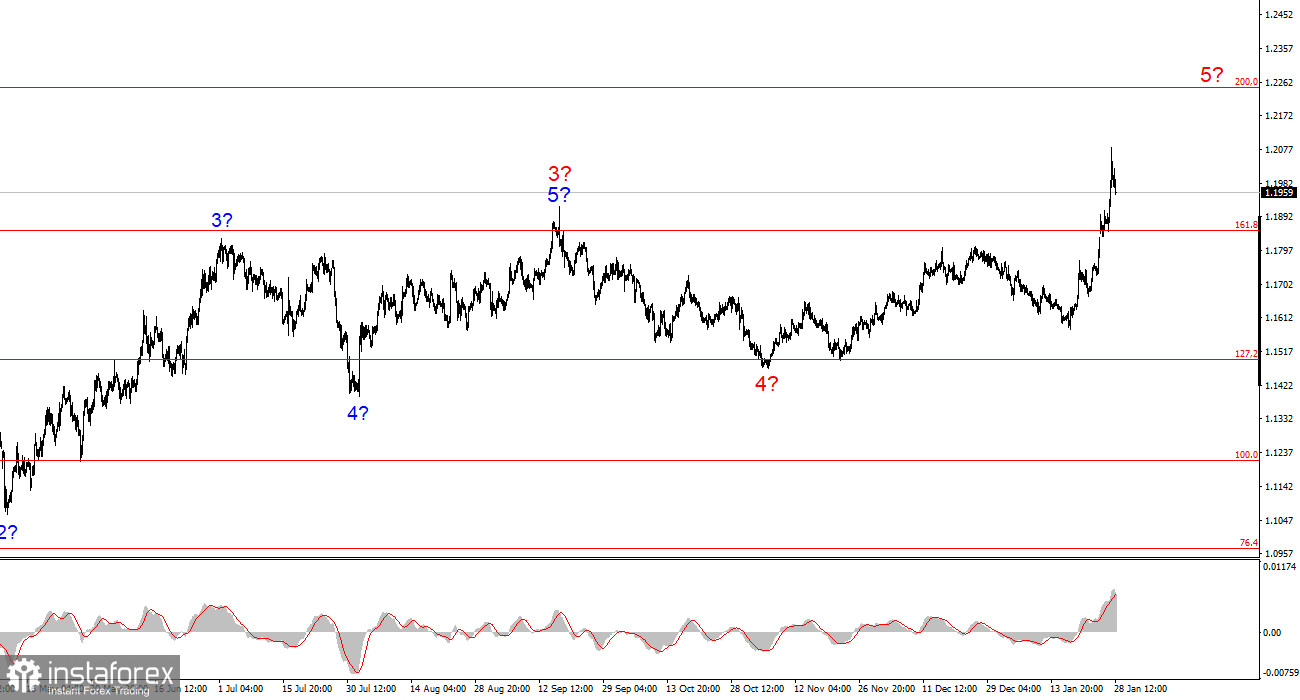
Based on the EUR/USD analysis, I conclude that the instrument continues to build an upward trend segment. Donald Trump's policies and the Fed's monetary policy remain significant long-term factors behind the decline of the U.S. dollar. The targets of the current trend segment may extend as high as the 1.25 level. At present, I believe that corrective wave 4 has completed its formation, so I expect further price appreciation. However, in the near term, I anticipate the development of a corrective wave.
On a smaller time scale, the entire upward trend segment is visible. The wave structure is not entirely standard, as corrective waves differ in size. For example, the larger wave 2 is smaller than the internal wave 2 within wave 3. However, this can also occur. I would like to remind you that it is best to identify clear and understandable structures on charts rather than strictly adhering to every individual wave. At present, the upward wave structure leaves little doubt.


