
यह भी देखें


 07.10.2026 08:39 AM
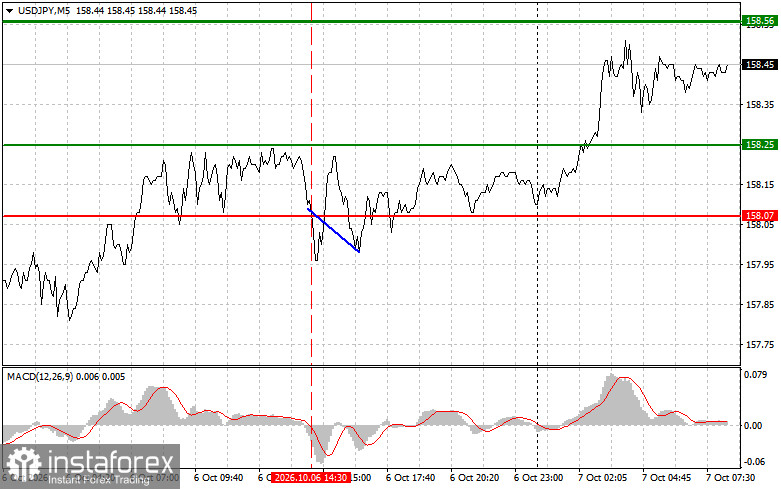
The test of 158.07 occurred as the MACD indicator began moving down from the zero line, confirming a good entry point to sell the dollar. As a result, the pair fell only about 10 pips.
The yen got a short breather yesterday when weak US external-trade data pushed USD/JPY lower. The goods and services deficit jumped to $105.6bn in August, so the pair's correction looked logical. This morning in Asian trading, dollar demand returned, and USD/JPY resumed its rise after yesterday's dip. That reminds us that a single weak US print is not enough to reverse sentiment; the yen was relying largely on its own mixed domestic data.
The main Japanese release this morning was the August wage report. Year-on-year growth was 3.8% versus a 3.7% forecast, but it slowed from 4.3% a month earlier — the deceleration is clear. That gives the Bank of Japan two signals at once. On one hand, wages slightly beat forecasts, and sustained household income growth is the primary argument for hawks to normalize policy — which is why Takata says Japan is no longer an outlier among developed economies. On the other hand, the slowdown from 4.3% to 3.8% gives the cautious wing reason to wait while consumption remains weak; the consumer-confidence index in September held only at 35.4.
The leading economic index for August printed 118.0 versus 118.1 expected. Compared with July's 117.7, the indicator improved, but it missed the forecast by a whisker — a combination that points to slow, tentative recovery rather than acceleration. Combined with the start-of-week data — services PMI down to 51.3 and composite PMI at 52.3 — the picture is coherent: the Japanese economy is still expanding, but momentum is fading, and wages do not yet justify a sharp rethink of BOJ plans. Ueda has previously urged greater attention to price-growth risks, and these data tend to support cautious normalization rather than a faster pace.
For the yen, the overall result is neutral, and against the backdrop of returning dollar demand that is not enough to stop USD/JPY's rise.
For intraday strategy, I will mainly rely on Scenario 1 and Scenario 2.
Scenario 1: Buy USD/JPY today if price reaches the entry area around 158.49 (green line) with a target of 158.73 (thicker green line). Around 158.73, I plan to exit long positions and open short positions for a counter-move (expecting 30–35 pips). Prefer to return to longs on corrections and significant pullbacks. Important: before buying, ensure MACD is above zero and only beginning its rise.
Scenario 2: Also buy if there are two consecutive tests of 158.34 while MACD is in the oversold area. This would limit downside potential and trigger an upward reversal. Expect moves toward 158.49 and 158.73.
Scenario 1: Sell USD/JPY only after the 158.34 level is breached (red line); this should lead to a rapid decline. Sellers' key target is 158.11, where I plan to exit shorts and immediately open longs for a counter-move (expecting 20–25 pips). Sellers can return at any moment — any hint from the central bank is enough. Important: before selling, ensure MACD is below zero and only beginning its decline.
Scenario 2: Also sell if there are two consecutive tests of 158.49 while MACD is in the overbought area. This would cap upside and trigger a downward reversal. Expect declines to 158.34 and 158.11.
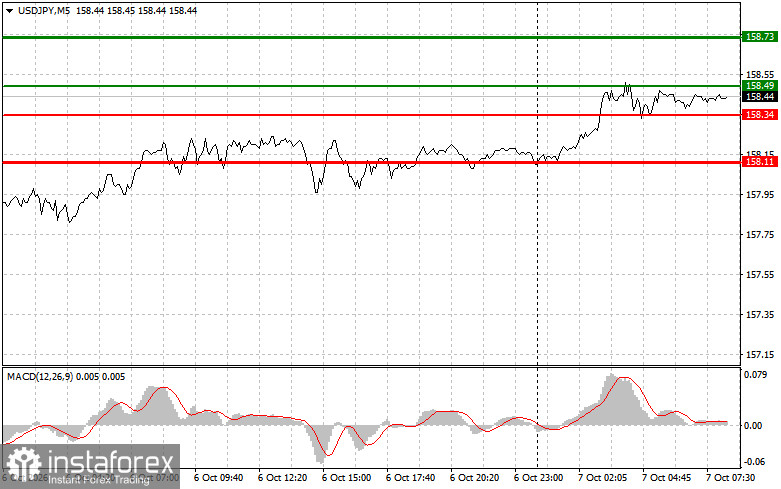
Thin green line – entry price at which you can buy the trading instrument.
Thick green line – approximate price where you can place Take Profit or manually lock in profits, since further upside above this level is unlikely.
Thin red line – entry price at which you can sell the trading instrument.
Thick red line – approximate price where you can place Take Profit or manually lock in profits, since further downside below this level is unlikely.
MACD indicator. When entering the market, it is important to follow the overbought and oversold zones.
Important. Beginner traders in the Forex market must be very cautious when making entry decisions. It is best to stay out of the market before the release of important fundamental reports to avoid getting caught in sharp price swings. If you decide to trade during news releases, always place stop orders to minimize losses. Without stop orders,, you can quickly lose your entire deposit, especially if you don't use money management and trade large volumes.
Remember that successful trading requires a clear trading plan, like the example above. Spontaneous trading decisions based on the current market situation are inherently a losing strategy for an intraday trader.

