
यह भी देखें


 29.07.2026 09:56 AM
Brent has risen nearly 4 percent, exceeding $87 per barrel, partially compensating for a 16 percent decline over the past three trading sessions, which marked the largest drop of its kind since 2020.

Since the beginning of July, the benchmark price has traded within a range of about $32, highlighting the exceptional volatility of the month. Currently, the September contract for Brent has added 3.8 percent to $87.24, previously rising by 4.8 percent to above $88. WTI for September delivery increased by 3.5 percent to $82.02.
The jump in prices was triggered by a new wave of hostilities that seriously undermined diplomatic efforts to resolve the months-long conflict. The Iranian state news agency IRIB News reported that the Islamic Revolutionary Guard Corps (IRGC) launched ballistic missile strikes on a US airbase and command center in Jordan. The IRGC also announced that it intercepted and stopped three tankers, without specifying the locations of the incidents.
However, US Central Command stated that it intercepted a "sudden" Iranian attack on American forces, without disclosing details, while American military forces, along with Saudi Arabia, struck Iran-linked terrorists in Iraq after the IRGC ordered them to attack American troops and the kingdom's energy infrastructure. Riyadh confirmed the joint operation with the US, stating that the strikes were conducted in self-defense.
The diplomatic track remains stalled due to the unresolved issue of control over the Strait of Hormuz. Iran informed Oman that its proposal to share control of the route through the strait in a 50-50 ratio does not address the Islamic Republic's concerns. Iran's Deputy Foreign Minister Kazem Garibabadi recently stated on state television that the incoming channel should be entirely under Iranian control, as should part of the outgoing. This fundamental position makes it nearly impossible to reach a compromise based on Oman's proposed terms.
Many experts remain highly skeptical that the countries are on the brink of a significant diplomatic breakthrough that will resolve the standoff that initiated the war. Data on actual shipping confirms this skepticism: visible traffic through the Strait of Hormuz remained low on Wednesday morning.
Alongside the escalation, attempts at diplomatic maneuvering continued in Washington. President Trump met with Israeli Prime Minister Benjamin Netanyahu, aiming to prevent the resumption of bombings; however, after the meeting, Netanyahu stated that he is skeptical about the possibility of reaching a deal.
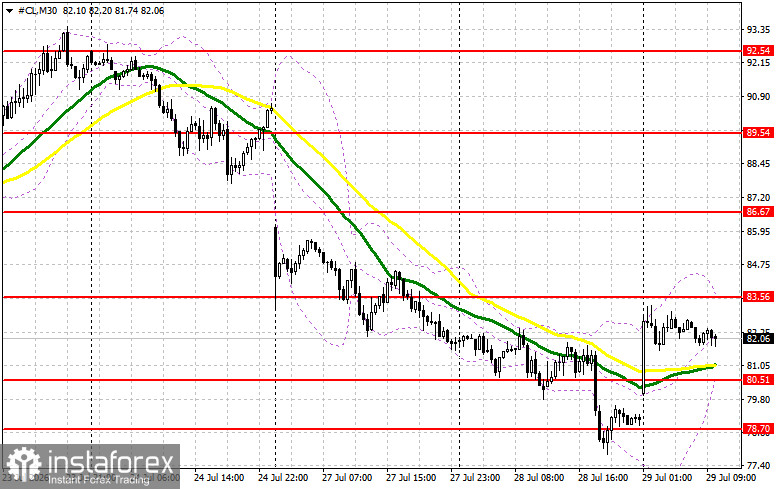
Regarding the current technical picture of oil, buyers need to overcome the nearest resistance at $83.56. This would allow targeting $86.67, above which it will be quite challenging to break. The furthest target will be in the $89.54 area. If oil falls, bears will attempt to take control at $80.50. If successful, breaking this range would deal a serious blow to bulls' positions and push oil down to a low of $78.70, with the prospect of dropping to $76.30.

