
আরও দেখুন


 23.06.2026 07:32 PM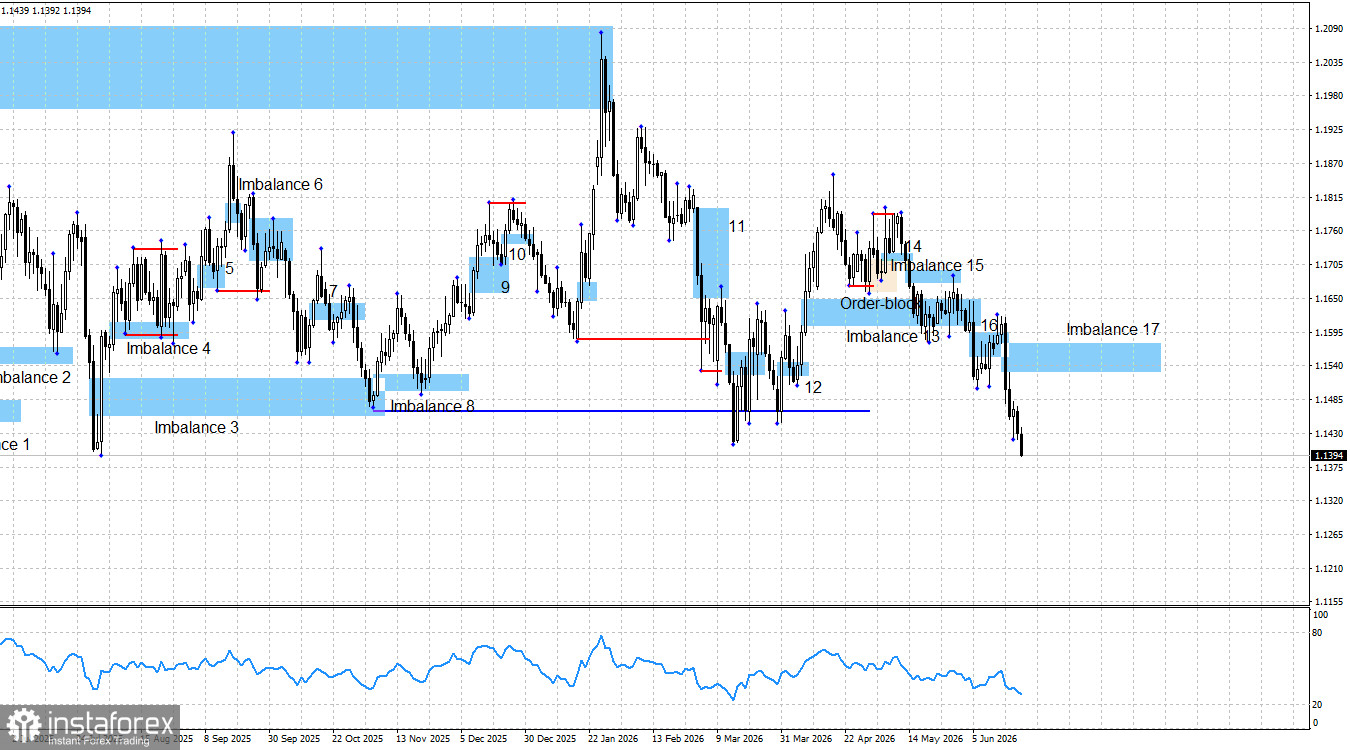
Last week, the EUR/USD pair declined by 190 points. A new week began, and the euro lost another 90 points. What is driving such an aggressive bearish advance?
At the moment, there is no talk of a renewed war in the Middle East, although Donald Trump threatened on Monday to launch new strikes against Iran if a nuclear agreement is not signed within 60 days. Trump also stated that the United States could establish control over the Strait of Hormuz and charge all vessels a fee for security services. Naturally, these remarks remain hypothetical at this stage and should not be taken too seriously. Negotiations between Tehran and Washington have begun, and both sides have two months to break the diplomatic deadlock. The very fact that a temporary ceasefire was signed last week already says a great deal.
However, traders are not merely holding the U.S. dollar as a safe-haven asset in case of a new escalation—they continue to buy it aggressively, as if the conflict in the Middle East had resumed and a blockade of the Strait of Hormuz had been accompanied by a closure of the Bab el-Mandeb Strait. The downward move has been so strong that price is not even attempting to rebalance into inefficiency zones (imbalances). As a result, traders currently have no trading signals despite the sharp market decline.
Geopolitics moved into the background last week. Tehran and Washington signed a memorandum of understanding, extended the ceasefire for 60 days, and began work on reopening the Strait of Hormuz. Nuclear negotiations officially began in Switzerland on Sunday. Nevertheless, we did not see the expected decline in the U.S. dollar as geopolitical tensions eased. Nor did we see euro strength following the ECB's monetary policy tightening. Bears simply refuse to relinquish control despite the fundamental and geopolitical backdrop. Under these circumstances, the best approach is to wait for the bearish advance to end—or at least for new sell signals to form.
Bearish Imbalance 16 ultimately held, but price moved above it, so I would not consider it a valid sell signal. In my opinion, without the Federal Reserve meeting, the pair would not have experienced such a sharp decline. Consequently, Bearish Imbalance 16 might well have been invalidated, and developments were moving in that direction. The current chart structure indicates that the bearish impulse that began on April 17 remains intact. The bearish imbalance was not fully traded and did not generate a sell signal. Today, liquidity may be taken below the lows of March 13, 2026, and August 1, 2025, but for now this remains only a faint hope for the bulls.
Once again, I cannot help but point out that the U.S. dollar's entire rally during January–March was driven solely by geopolitical factors. As soon as the United States and Iran agreed to a ceasefire, bears immediately retreated, and for more than a month the bulls dominated market activity. The agreement has now been signed, and the market was preparing for a renewed rise in EUR/USD, but the Federal Reserve's shift toward a more hawkish stance provided strong support for the dollar. The question is: how much longer can the market continue pricing in this single factor?
Tuesday's economic data certainly did not improve sentiment among the bulls. Of the four PMI reports from Germany and the Eurozone covering the manufacturing and services sectors, three came in below expectations. One could therefore argue that today's economic data triggered the euro's decline. However, I do not believe that is the case. The pair has been falling for an entire week. Monday also ended with losses despite the absence of any particularly weak economic data from the European Union.
There are still plenty of reasons for the bulls to remain active in 2026, and the conflict in the Middle East has not reduced their number. Structurally and globally, Trump's policies—which led to a significant decline in the dollar last year—have not changed. At present, I do not see any major long-term support factors for the U.S. currency despite the FOMC's hawkish stance. EUR/USD has approached a series of lows and swing points where liquidity may be taken, potentially serving as a signal for a reversal of the current bearish impulse.
Economic Calendar for the United States and the Eurozone:
The June 24 economic calendar contains only two events, neither of which is considered major. Therefore, economic data is unlikely to have a meaningful impact on market sentiment on Wednesday.
EUR/USD Forecast and Trading Advice:
In my view, the pair remains in the process of forming a broader bullish trend. The fundamental backdrop shifted sharply in favor of the bears four months ago, but the trend itself cannot yet be considered canceled or completed. Therefore, bulls may begin a new advance after liquidity is taken below clearly defined lows. However, opening long positions at the current stage is not advisable. First, the bearish impulse needs to be completed and bullish patterns need to emerge.
At present, traders should wait for the formation of new patterns, preferably bullish ones. Last week, Bearish Imbalance 17 formed and can still be used for opening short positions. However, I would draw attention to the proximity of four significant swing points from which liquidity may be taken, after which a new bullish impulse could begin.


